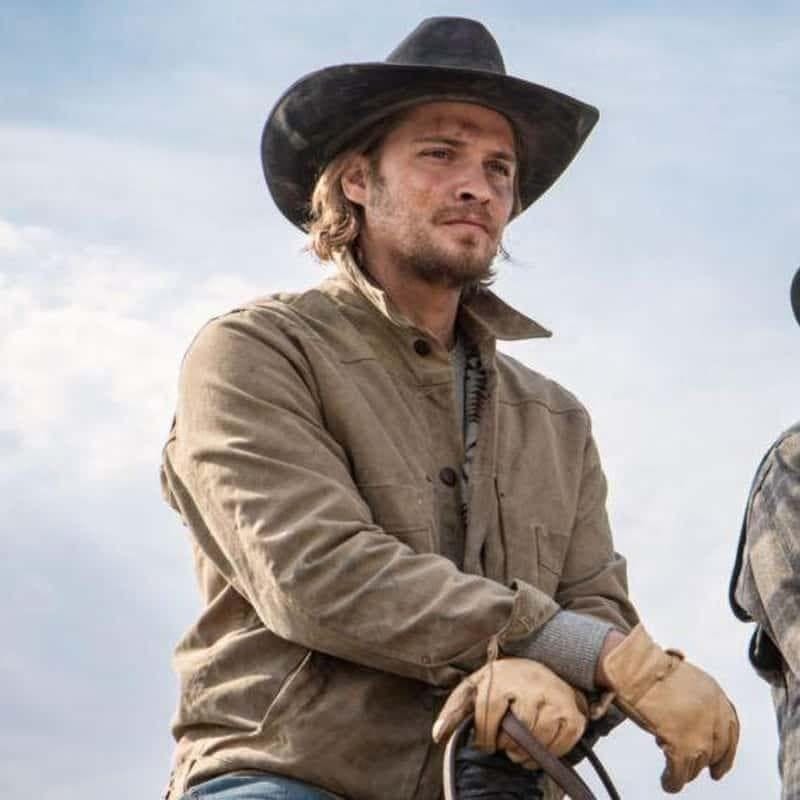
A man caught between two worlds—the ranch life he left behind and the law enforcement path that lies ahead
“Piya Wiconi” — The Lakota term for “new beginning” that gives the series premiere its title, perfectly encapsulating the transformation at the heart of CBS’s latest Yellowstone spinoff.
Introduction: The Weight of Legacy and the Promise of Renewal
When the curtain fell on Yellowstone in late 2024, Kayce Dutton had achieved what seemed impossible for any member of the notorious Dutton clan: a peaceful ending. Riding into the Montana sunset with his wife Monica and son Tate, Kayce appeared to have finally escaped the cycle of violence, betrayal, and tragedy that had consumed his family for generations. The final scenes of the flagship series suggested that this quiet rancher, who had always worn his heart on his sleeve amidst a family of hardened cynics, had finally found his slice of heaven.
But peace, as we learn in the opening moments of Marshals, was merely the calm before the storm.
CBS’s Marshals represents more than just another extension of Taylor Sheridan’s wildly successful neo-Western franchise—it marks a fundamental reimagining of what a Yellowstone story can be. By transplanting Kayce Dutton from the sprawling family ranch into the structured world of federal law enforcement, the series forces both its protagonist and its audience to confront uncomfortable questions about identity, grief, and the possibility of redemption after unimaginable loss.
This is not simply a story about a cowboy who becomes a cop. It is a profound exploration of how a man rebuilds himself when everything he loves is stripped away, and how the very skills that once isolated him from his family become the foundation for a new purpose.
Chapter 1: The Illusion of Peace — Understanding Yellowstone’s Deceptive Finale
To fully appreciate the magnitude of Kayce’s transformation in Marshals, we must first understand where he stood at the conclusion of Yellowstone. The series finale seemed to offer Kayce everything he had ever wanted: distance from his domineering father John Dutton, a peaceful existence on a quiet corner of the ranch, and most importantly, the intact family he had fought so hard to protect throughout five tumultuous seasons.
Luke Grimes, who has embodied Kayce since 2018, described this ending in interviews as the character’s “fairytale ending.” Kayce had rejected the poisoned inheritance of the Dutton legacy, choosing instead to prioritize his immediate family’s wellbeing over the endless territorial wars that had claimed the lives of so many relatives. This decision aligned perfectly with what Grimes has identified as the core of Kayce’s character: “Being a cowboy was at the heart of his character. He wanted his little slice of heaven and some cattle. Every other Dutton wanted the world.”
Yet there was always an element of fragility to this happiness. Kayce’s entire arc in Yellowstone had been defined by his inability to fully escape the gravitational pull of his family’s dysfunction, no matter how far he tried to run. His marriage to Monica, a member of the Broken Rock Reservation, represented his attempt to build bridges across the very divides that his father had weaponized. His complicated relationship with his SEAL past, which manifested in visions and psychological trauma, suggested that inner peace remained elusive despite external circumstances.
The finale’s peaceful imagery—the family riding together, the quiet acceptance of a simpler life—now reads as almost unbearably poignant in retrospect. Like so many moments of happiness in the Dutton universe, it was destined to be temporary.
Chapter 2: The Unthinkable Loss — What Happened Between Series
Marshals opens with a narrative bombshell that fundamentally restructures everything we thought we knew about Kayce’s trajectory. While critics have been restricted from explicitly detailing the nature of this loss in early reviews (a decision that has sparked considerable debate about spoiler culture), the impact is immediate and devastating: the life Kayce built, the peace he fought for, has been shattered by forces beyond his control.
In interviews promoting the series, Grimes has been candid about the emotional weight of this premise. “[Before Marshals starts], the worst thing that could possibly happen to him happens,” the actor explained to TV Insider. This statement, while deliberately vague, speaks volumes about the show’s emotional stakes. For a character who has already survived military combat, family warfare, and spiritual crisis, what could constitute the “worst thing”?
The premiere episode, titled “Piya Wiconi” (Lakota for “new beginning”), handles this revelation with surprising restraint. Rather than dwelling on the mechanics of the tragedy, it focuses on the aftermath—specifically, how Kayce navigates a world where his primary motivation for the past decade (protecting his family unit) has been fundamentally altered. He is now a single father, raising his teenage son Tate while grappling with grief that threatens to consume him entirely.
This narrative choice does more than simply provide an inciting incident for the new series. It forces Kayce to confront a terrifying question: who is he without the relationships that defined him? Throughout Yellowstone, Kayce’s identity was always relational—he was John’s son, Monica’s husband, Tate’s father, the bridge between two worlds. Stripped of the central pillar of his marriage, he must now discover if there is a core self capable of sustaining him through the darkness.
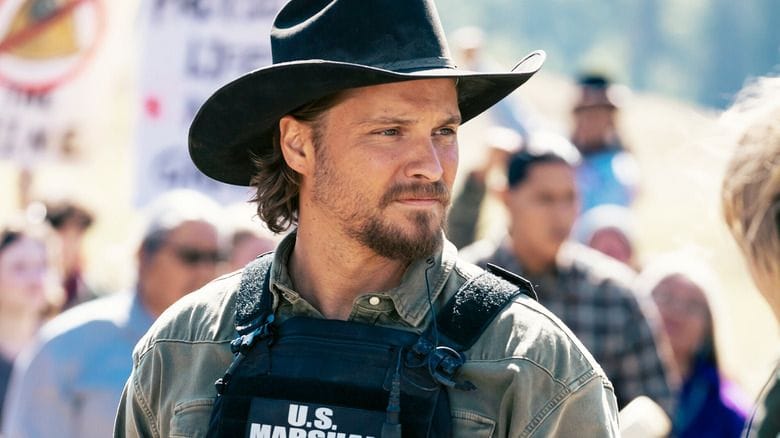
The process of reconstruction: Kayce must rebuild his identity from scattered pieces of who he once was
Variety’s review of the premiere noted this transformation with particular insight: “The context nonetheless renders Kayce even more of a stripped-down lone actor, ready to be plugged into a new setup with minimal ‘Yellowstone’ baggage.” Yet this description, while accurate on a plot level, misses the profound emotional complexity of what we witness. This is not merely a character being streamlined for a procedural format; it is a man undergoing the most painful kind of reinvention.
Chapter 3: Piya Wiconi — The Meaning of a New Beginning
The choice to title the premiere episode with a Lakota phrase is no accident. It signals Marshals’ commitment to honoring the indigenous perspectives that were often marginalized in the original series, while also encapsulating the show’s central thematic concern: the possibility of genuine renewal after catastrophic loss.
For Kayce, this new beginning arrives not through choice but through necessity. When we encounter him in the premiere, he is functionally frozen—going through the motions of daily life while internally suspended in grief. The intervention that breaks this paralysis comes from an unexpected source: his former Navy SEAL teammate Pete Calvin, played with compelling intensity by Logan Marshall-Green.
Calvin’s role in Kayce’s transformation cannot be overstated. Unlike the various authority figures who populated Kayce’s life in Yellowstone—his overbearing father, the tribal leaders, the politicians—Calvin represents a different kind of influence. He understands the specific trauma of combat, the difficulty of reintegration into civilian life, and the peculiar burden of having been trained to kill in service of abstract ideals. When he approaches Kayce with the offer to join an elite U. S. Marshals unit, he frames it not as an escape from grief but as a channel for it.
“Working with the Marshals might help Kayce deal with his own demons,” Calvin suggests, articulating the show’s central premise with surprising directness. This proposition—that purposeful action can transmute unprocessable pain into something socially valuable—represents a fundamentally different approach to trauma than we saw in Yellowstone. Where the flagship series often depicted its characters becoming trapped in cycles of retribution and violence, Marshals proposes the possibility of directed, institutionalized action as a form of healing.
Grimes has spoken about the significance of this transition in his own career. “It was one of the best nights of the shoot,” he recalled of filming campfire scenes with his new castmates. “In the scene, we’re supposed to be bonding, and I felt it actually happening [in real life].” This blurring of performance and reality suggests something profound about the therapeutic potential of community—a theme that runs throughout the series premiere.
Chapter 4: From Cowboy Skills to Law Enforcement — The Evolution of Competence
One of the most intriguing aspects of Marshals is how it validates Kayce’s seemingly disparate skill set as a coherent professional toolkit. Throughout Yellowstone, his dual identity as cowboy and former Navy SEAL often felt like sources of tension—different parts of himself that he struggled to integrate. The ranch required patience, tradition, and connection to the land. The military had demanded lethal efficiency, strategic thinking, and emotional detachment.
Marshals brilliantly synthesizes these capacities by placing Kayce in a role that genuinely requires both. As a U. S. Marshal operating in rural Montana, he must navigate terrain that demands horseback riding, survival skills, and understanding of the local ecosystem—all cowboy competencies. Simultaneously, he faces organized threats (the premiere involves hunting down a bomber targeting the Broken Rock Reservation) that require tactical planning, weapons expertise, and the ability to function under extreme stress—his SEAL training.
This professional synthesis mirrors the character’s psychological journey. Where once Kayce felt torn between conflicting identities, he now inhabits a role that makes his contradictions coherent. The premiere’s most effective action sequences leverage this duality, showing Kayce seamlessly transitioning between tracking suspects on horseback and conducting tactical entries, between reading the land and reading human behavior.
The showrunner Spencer Hudnut, whose background includes writing and producing on SEAL Team, clearly understands the technical aspects of both military and law enforcement work. But more importantly, he understands how these competencies can serve character development. In interviews with Parade, Hudnut described Marshals as a “non-traditional procedural” that “takes the elements of Yellowstone and blends them into a CBS show.” This hybrid approach allows the series to maintain the emotional depth that characterized the flagship while delivering the satisfying case-of-the-week structure that broadcast audiences expect.
For Kayce specifically, this professional context provides something crucial that was often missing in Yellowstone: a sense of earned competence that isn’t constantly undermined by family dysfunction. On the ranch, no matter how skilled Kayce became as a livestock handler or range rider, he remained fundamentally subordinate to his father’s authority and the chaotic demands of Dutton family politics. As a Marshal, his skills are valued on their own merits, and his success or failure depends on his own choices rather than the whims of an unpredictable patriarch.
Chapter 5: The Double Burden — Fatherhood and Federal Service
If Marshals were simply a story about a skilled operative finding renewed purpose through meaningful work, it would be engaging but hardly unique. What elevates the series is its unflinching examination of how Kayce’s professional rebirth complicates rather than resolves his most important role: being a father to Tate.
Brecken Merrill returns as Tate Dutton, now a teenager rather than the young boy we met in Yellowstone’s early seasons. This casting continuity provides essential emotional grounding, reminding us that while Kayce may be entering a new chapter, he cannot simply discard the past. Tate represents living memory—the daily reminder of what has been lost and what must be preserved.
The dynamic between father and son in the premiere is heartbreaking in its authenticity. Kayce, desperate to protect the one family member he has left, finds himself drawn to increasingly dangerous work. Tate, simultaneously craving his father’s attention and resenting his emotional absence, must navigate adolescence without the maternal presence that once provided stability. Both are grieving; neither knows how to comfort the other.
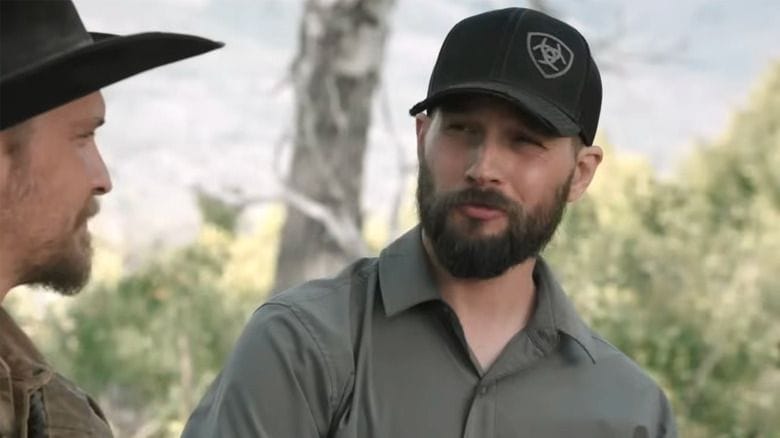
The campfire scene: A moment of connection amidst the silence of shared grief
Grimes has identified this relationship as central to understanding Kayce’s psychology in Marshals. “The fact that he doesn’t want to be like his father and wants to set a new example for his son is special,” the actor noted, drawing a direct line between his character’s past and present. John Dutton was notorious for trying to control his adult children’s lives, for weaponizing inheritance and obligation to maintain power. Kayce is determined to break this cycle, yet he risks replicating it through absence and emotional unavailability.
The show’s writers deserve credit for refusing easy answers to this dilemma. There is no moment in the premiere where Kayce achieves balance, no epiphany that resolves the tension between his duties as a father and his commitment to law enforcement. Instead, we see him stumble—apologizing to Tate in one of the episode’s most affecting scenes for failures he cannot yet fully articulate or prevent.
This willingness to sit with discomfort, to acknowledge that redemption is a process rather than an event, distinguishes Marshals from more simplistic law enforcement procedurals. Kayce’s journey is not about becoming a hero who saves the day and returns home for heartwarming family dinners. It is about learning to carry multiple, often conflicting responsibilities without being destroyed by their weight.
Chapter 6: Bridging Worlds — The Broken Rock Connection
One of the most significant through-lines from Yellowstone to Marshals is Kayce’s complicated relationship with the Broken Rock Reservation. In the original series, this connection was primarily defined through his marriage to Monica—an alliance that brought him both profound love and endless complications. With Monica’s absence in the new series (the specific circumstances of which the show handles with appropriate gravity), one might expect this aspect of Kayce’s life to fade into the background.
Instead, Marshals makes the Broken Rock connection more central than ever—and more complicated. The series premiere’s case involves a bomber specifically targeting the reservation, forcing Kayce to confront the limits of institutional law enforcement in addressing crimes against indigenous communities. He cannot simply arrest his way to justice; he must navigate the same jurisdictional complexities, cultural sensitivities, and historical grievances that have always characterized this territory.
The return of Gil Birmingham as Thomas Rainwater and Mo Brings Plenty as Mo provides essential continuity while also marking change. These are not the same characters we left in Yellowstone; years have passed, circumstances have shifted, and the alliances that once seemed stable have been tested by time and tragedy. Rainwater’s cautious endorsement of Kayce’s new role—his reassurance that Kayce is “not like them [the Duttons] at all”—carries the weight of their shared history while acknowledging the new context.
The Hollywood Reporter’s review noted this dynamic with particular acuity: “The few reassurances he gets (including from another Yellowstone holdover, Gil Birmingham’s tribal chairman Thomas Rainwater) that he’s not like them at all, he clings to like a lifeline.” This observation cuts to the heart of Kayce’s psychological state. Having lost the relationship that most clearly distinguished him from his family’s toxic legacy, he desperately seeks external validation that he remains fundamentally different from the Duttons who came before him.
The reservation setting also allows Marshals to address themes that Yellowstone often approached clumsily. By placing indigenous characters and concerns at the center of its narrative rather than at the margins, the spinoff demonstrates a maturation of the franchise’s engagement with Native American issues. The premiere’s depiction of Broken Rock is neither romanticized nor demonized; it is presented as a complex community facing real challenges that require nuanced responses.
Chapter 7: The New Team — Finding Family in Professional Community
If Yellowstone was fundamentally a story about the burdens of biological family, Marshals explores the possibilities of chosen professional community. The elite U. S. Marshals unit that Kayce joins represents a different model of affiliation—one based on shared competence, mutual respect, and common purpose rather than blood obligation.
The premiere introduces us to Kayce’s new colleagues with commendable efficiency. There’s Belle Skinner (Arielle Kebbel), whose seemingly straightforward competence masks hidden depths (the episode’s final revelation that she is actually “Isabel Turek,” a local from a horse-breeding family, suggests intriguing backstory). Andrea Cruz (Ash Santos), the Bronx transplant whose outsider perspective provides necessary contrast to Montana insularity. Miles Kittle (Tatanka Means), who shares Kayce’s indigenous connections while bringing his own complicated history to the team.
Each of these characters represents a potential relationship that could develop over the season, but the premiere wisely resolves none of them. We see initial tensions, tentative connections, and the first hints of the trust that will (presumably) develop, but there is no rush to replicate the intense bonds that took seasons to establish in Yellowstone.
This restraint serves the show’s themes admirably. Kayce cannot simply replace his lost family with a new work family; such a substitution would cheapen the grief he is experiencing and ignore the genuine differences between personal and professional relationships. Instead, Marshals suggests that these new connections may offer something equally valuable but fundamentally distinct: the possibility of being known and valued for one’s capabilities rather than one’s bloodline.
Grimes has spoken about the real-world camaraderie that developed among the cast during production, noting how those bonds informed the on-screen relationships. “I slept a lot less than I had in most of my life because I’m doing 70-hour weeks,” he told TV Insider, describing the intensity of leading a series for the first time. This behind-the-scenes dedication to the work translates into performances that convey genuine investment in the material.
Chapter 8: The Visions Continue — Trauma’s Persistent Voice
One of the most distinctive elements of Kayce’s character in Yellowstone was his experience of visions—moments where the boundary between spiritual and material reality seemed to blur. These visions often carried prophetic weight, warning him of dangers or guiding his decisions in ways that rational analysis could not.
Marshals continues this supernatural element, most strikingly in the premiere’s final moments. After accepting his new role by literally shooting the wolf that has appeared to him throughout the episode—a symbolic rejection of his former self and embrace of his new identity—Kayce seems to have definitively closed one chapter. Yet the show makes clear that such closure is never complete.
This persistence of trauma, its refusal to be simply overcome through willpower or symbolic action, represents one of Marshals’ most honest narrative choices. Kayce cannot shoot his grief away any more than he could outrun his past. The visions will continue; the wounds will reopen; the process of healing will be nonlinear and frustrating.
What the series proposes, however, is that meaningful action remains possible even in the midst of ongoing trauma. Kayce does not need to be “healed” to be effective; he does not need to have processed all his grief before he can contribute to his community. His pain, properly channeled through his work as a Marshal, becomes a source of empathy and insight that purely professional law enforcement officers might lack.
This represents a mature understanding of trauma’s role in human experience. Rather than treating psychological wounds as problems to be solved before normal life can resume, Marshals suggests that we must learn to carry our wounds while continuing to function, to be of service, to build meaning even when completeness eludes us.
Conclusion: The Road Ahead
As “Piya Wiconi” draws to a close, Kayce Dutton stands at the threshold of a journey whose destination remains unclear. He has accepted a new role, joined a new team, and taken the first steps toward a different kind of life. Yet the premiere makes no promises about where this path will lead or whether it will ultimately deliver the redemption he seeks.
This ambiguity is Marshals’ greatest strength. By refusing to offer easy answers or guaranteed happy endings, the series honors the complexity of real grief and the genuine difficulty of personal transformation. Kayce’s journey from rancher to law enforcement officer is not simply a change of profession; it is a fundamental renegotiation of identity, purpose, and meaning in the wake of catastrophic loss.
Luke Grimes, who has grown remarkably as an actor across his tenure in the Yellowstone universe, brings unprecedented depth to this iteration of Kayce. No longer the conflicted son or the struggling husband, he must embody a man who has lost everything and must now discover if there is anything left to build upon. It is a performance of remarkable restraint and vulnerability, suggesting that the best may still be ahead for both actor and character.
For audiences, Marshals offers something rare in the current television landscape: a genuinely adult exploration of how we continue living when everything we valued has been taken from us. It does not promise that hard work leads to success, that grief eventually resolves into acceptance, or that the good are rewarded and the wicked punished. Instead, it suggests something more modest but ultimately more profound: that even in our darkest moments, we retain the capacity to choose meaningful action, to serve something larger than ourselves, and to gradually, imperfectly, build new lives from the ruins of the old.
“Piya Wiconi”—new beginning—is not a destination but a process. For Kayce Dutton, that process has just begun.
About This Analysis
This article draws on the series premiere of Marshals, interviews with cast and creators, and critical reception of the show’s debut. Marshals airs Sundays at 8:00 PM ET/PT on CBS and streams on Paramount+.
For more analysis of the Yellowstone universe and neo-Western storytelling, follow DuttonLegacy.com