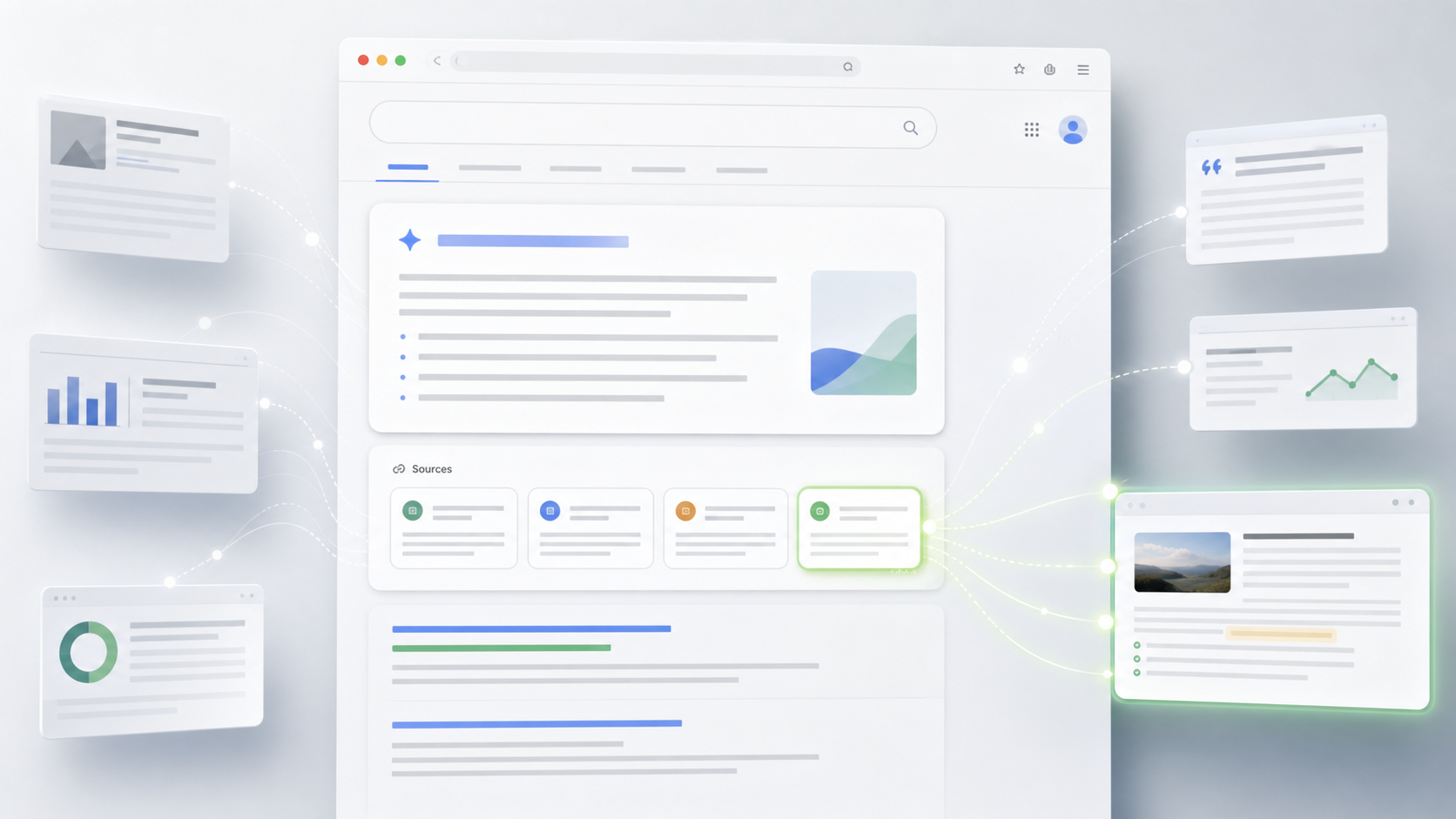
The wrong way to think about Google AI Overviews is: “How do I trick Google into citing my page?”
The better question is: What kind of page is useful enough to become part of an answer?
That distinction matters.
Classic SEO was already about usefulness, but AI Overviews make the test sharper. A normal search result can rank because the whole page is relevant. An AI Overview citation has a harder job: it needs to support a specific claim, comparison, definition, caveat, example, or next step inside a generated answer.
In other words, it is not enough for your page to be “about the topic.” It has to contain a piece of information that is easy to trust, extract, and connect to the user’s question.
This article is the practical follow-up to my earlier piece on Google Zero. That article was about the big shift: easy clicks are disappearing. This one is about what to do next.
If small publishers want to survive AI search, they need to stop writing only for rankings and start writing for citation-worthiness.
Quick answer: how do you get cited in Google AI Overviews?
There is no guaranteed way to get cited in Google AI Overviews, but the practical path is clear: publish pages that are crawlable, indexed, easy to understand, and useful enough to support one specific part of an AI-generated answer. The best pages answer a clear question early, support claims with nearby evidence, include current dates and caveats, and add original experience or judgment that a generic summary cannot replace.
For small publishers, the goal is not to become the biggest page on the topic. The goal is to become the most useful supporting source for one sub-question: a definition, checklist, comparison, example, caveat, workflow, or mistake pattern that an AI Overview needs in order to answer well.
Key takeaways
- AI Overview citations are not identical to traditional organic rankings.
- Question-style searches are much more likely to trigger AI-generated summaries.
- Query fan-out means Google may look for sources that answer sub-questions, not only the broad query.
- Technical access still matters: a blocked, hidden, or weakly linked page is harder to retrieve.
- The most citation-friendly pages separate claims, evidence, caveats, and recommendations.
- Small blogs should compete on firsthand examples, narrow workflows, and clear judgment.
1) The click problem is real
The first reason this matters is simple: AI summaries reduce the easy click.
Pew Research Center analyzed Google search behavior from March 2025 and found that people who encountered an AI summary clicked a traditional result in 8% of visits, compared with 15% when no AI summary appeared. Clicks on the AI summary sources themselves were even rarer: only 1% of visits to pages with an AI summary.
That does not mean nobody clicks. It means the click becomes more selective.
The user has already received a partial answer. If they click, it is because they need something beyond the summary:
- more evidence
- a clearer example
- a step-by-step process
- a stronger opinion
- a source they can trust
- a detail the summary did not fully explain
That is why “getting cited” is not the same as “getting traffic.” A citation may not always produce a click. But if AI Overviews become a major discovery layer, being absent from them may be worse than receiving fewer but higher-intent visits.
The game is changing from “win the first click” to “become the source people still want after the summary.”
2) AI Overviews are not just classic rankings with a paragraph on top
The strongest recent evidence comes from a May 2026 paper, Measuring Google AI Overviews. The authors issued 55,393 trending queries across 19 topic categories from March 13 to April 21, 2026.
Their headline numbers are worth sitting with:
- AI Overviews triggered for 13.7% of all tested queries.
- For question-form queries, activation rose to 64.7%.
- Nearly 30% of cited domains did not appear in the co-displayed first-page results.
- 11.0% of the atomic claims they checked were not supported by the cited pages.
For publishers, the most important part is the third point.
If nearly a third of cited domains are not on the visible first page, then AI Overview inclusion is not just a reward for ranking in position one. Google may pull supporting sources from a wider set of pages than the classic results would suggest.
That is both good and uncomfortable.
It is good because a small publisher does not necessarily need to beat every giant domain in the standard ranking block to be useful. It is uncomfortable because the selection logic is harder to observe. You cannot simply say, “I rank third, therefore I should be cited.”
The more useful working model is:
Classic ranking decides whether your page is broadly relevant. AI Overview citation decides whether a specific part of your page helps build the answer.
3) Case study: question queries are where the action is
The same May 2026 paper found much higher AI Overview activation for question-style searches. Pew’s analysis also points in that direction: searches beginning with question words generated AI summaries far more often than short keyword fragments.
That matters because many small publishers still plan content around old keyword syntax:
- “best AI SEO tools”
- “programmatic SEO definition”
- “Google AI Overview ranking”
Those topics still matter, but AI search is increasingly shaped by full questions:
- “How do I get my blog cited in AI Overviews?”
- “Why is my page ranking but not appearing in AI summaries?”
- “What should a small site change after Google Zero?”
- “Which content types are still worth writing when AI summaries answer basic questions?”
This changes how I would build a page.
I would not only target the keyword. I would map the real question path:
- What is the user trying to decide?
- What false belief do they probably have?
- What specific example would help them trust the answer?
- What caveat would prevent the page from sounding like SEO folklore?
- What next action should they take after reading?
AI Overviews are more likely to appear when the query is complex enough to benefit from synthesis. So the page that wants to be cited should be built around synthesis too.
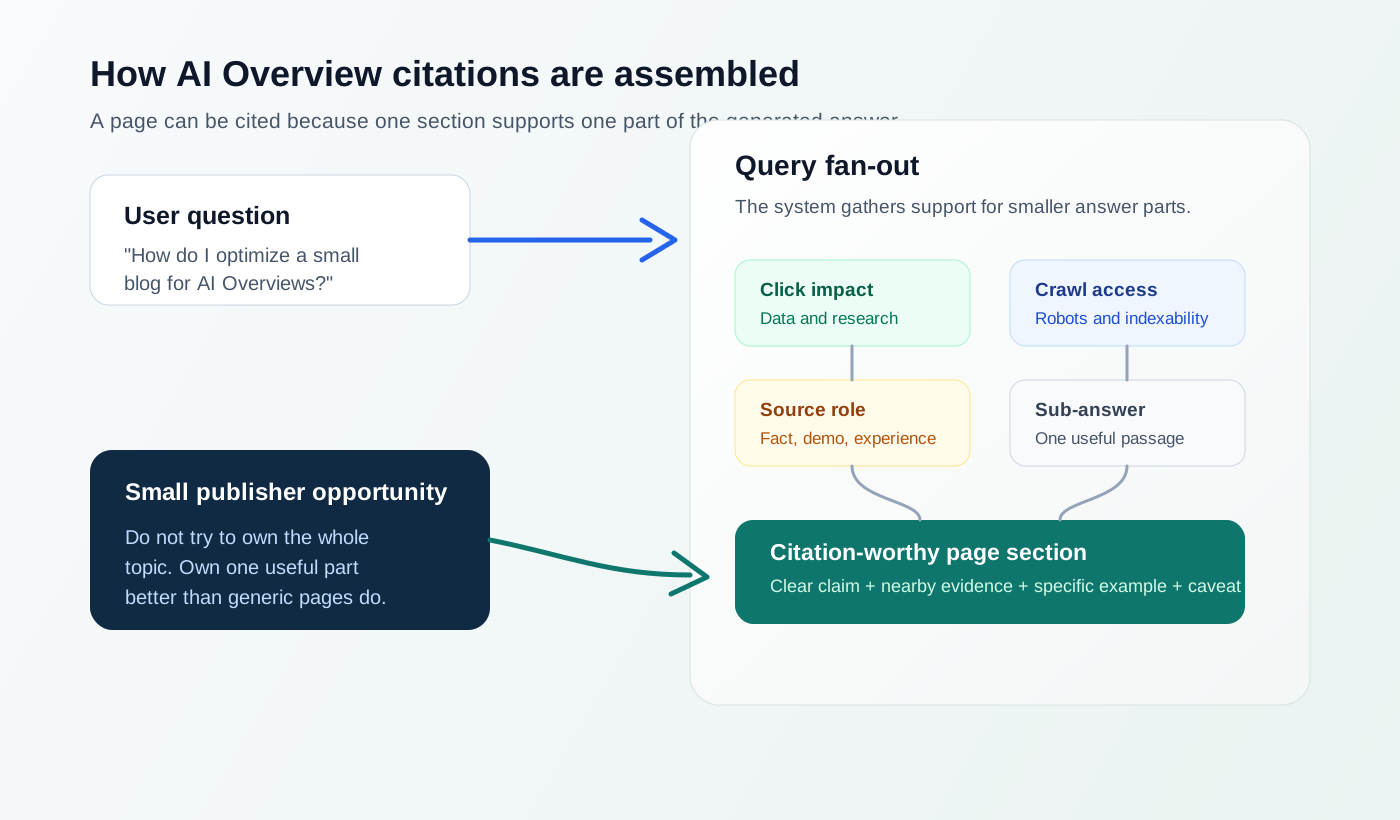
4) Case study: query fan-out rewards pages that answer sub-questions
Google’s own explanation of AI Mode is important here. In its 2025 AI Search update, Google described query fan-out: the system breaks a question into subtopics and issues multiple related searches to gather a deeper answer.
Google’s Search Central documentation says AI Overviews and AI Mode may both use this kind of fan-out technique, identifying supporting pages across related subtopics and data sources.
That is a big hint.
If Google is decomposing a complex question into sub-questions, then a page can be useful even if it does not answer the entire broad query. It may be selected because it answers one part especially well.
Example:
The broad query might be:
“How do I optimize a small blog for AI Overviews?”
Google might need supporting material for:
- whether AI Overviews reduce clicks
- whether AIO citations overlap with organic rankings
- whether blocking AI crawlers affects retrieval
- what Google officially recommends
- what kind of content is easy to extract
- how to measure the impact in Search Console
A small publisher probably cannot own the entire broad topic against Google, Pew, arXiv papers, Search Engine Land, and major SEO platforms.
But a small publisher can own one narrow, highly useful sub-answer:
- “Here is the exact content audit checklist I use before publishing an AI-search-ready article.”
- “Here are five examples of pages that rank but are not citation-friendly.”
- “Here is how to rewrite a generic comparison page so it can support AI Overview claims.”
The opportunity is not to be the biggest page. The opportunity is to be the best supporting page for one part of the answer.
5) Case study: crawler access still matters
Another 2026 paper, How Generative AI Disrupts Search, compared Google Search, AI Overviews, and Gemini Flash 2.5 across 11,500 user queries.
One of its most practical findings: websites that block Google’s AI crawler were significantly less likely to be retrieved by AI Overviews, even when the content itself was accessible.
That is not glamorous advice, but it matters.
Some publishers are understandably angry about AI search. They want to limit how their content is used. That is a business decision, and for some sites it may be reasonable. But if your goal is to appear in AI Overviews, you cannot treat crawler access as an afterthought.
At minimum, a small publisher should check:
- the page is indexed
- important content is visible in text
- robots.txt does not block the relevant Google crawling path
- CDN or firewall rules do not accidentally block Googlebot
- the page can show a normal snippet in Google Search
- internal links make the page discoverable
This lines up with Google’s own Search Central guidance. Google says there are no special technical requirements for AI Overviews beyond being indexed and eligible for a snippet. It also recommends the familiar basics: crawlability, internal links, page experience, textual content, useful images or videos, and structured data that matches visible page content.
That may sound boring, but boring technical problems still kill visibility.
6) Case study: Wikipedia, YouTube, Reddit, and .gov tell us what Google values
Pew’s analysis found that Wikipedia, YouTube, and Reddit were among the most frequently cited sources in both AI summaries and standard results. It also found that government sites made up a larger share of AI summary sources than standard results.
I would not interpret that as “go post on Reddit and win AI Overviews.”
The better lesson is that AI summaries need different kinds of support:
- Wikipedia often gives stable definitions and consensus framing.
- YouTube can provide demonstrations and visual explanations.
- Reddit can surface lived experience, edge cases, and user language.
- Government sites often provide high-trust factual grounding.
For a small publisher, this is a useful pattern.
Do not try to imitate Wikipedia, YouTube, Reddit, or .gov sites. Instead, ask what role your page can play in the answer.
Your page might be:
- the practical workflow source
- the field-tested comparison
- the clear definition with caveats
- the first-person implementation note
- the niche buyer’s guide
- the mistake list that generic pages avoid
AI Overviews do not need every source to serve the same purpose. A strong answer needs facts, examples, interpretation, and sometimes experience. Small blogs should compete where they can add experience and interpretation, not where they are weakest.
7) Case study: GEO research shows that wording and evidence change visibility
The 2024 paper GEO: Generative Engine Optimization is not specifically about Google AI Overviews, but it is useful because it studies how content visibility changes inside generative answers.
The authors found that generative engine visibility could be improved substantially through content changes, but the effective strategy varied by domain. The point is not that there is one magic template. The point is that generative systems respond to content that is easier to use inside an answer.
In practice, I would translate that into a few writing habits:
- State the answer directly before expanding it.
- Put evidence close to the claim it supports.
- Use specific examples instead of abstract advice.
- Include dates when freshness matters.
- Name the limitation of your advice.
- Make comparison points explicit.
- Use headings that match real reader questions.
This is not about stuffing the page with “AI Overview” keywords. It is about making each section easier to cite without stripping away the human judgment.
8) What a citation-friendly page looks like
If I were rewriting a page to increase its chance of being cited in AI Overviews, I would not start by adding schema markup. I would start by making the page more useful at the sentence and section level.
A citation-friendly page has seven traits.
1. It answers one clear question
The page should have a main question that a search system can recognize.
Weak:
“AI Search Strategy Guide”
Better:
“How should a small blog write content that can be cited in AI Overviews?”
The second version is less grand, but more useful.
2. It gives the short answer early
Do not bury the point.
A good page should make its answer clear in the first few paragraphs, then use the rest of the article to explain, prove, and qualify it.
3. It separates claims, evidence, and opinion
AI-generated answers need support. Readers need trust.
So make the structure visible:
- “Here is what the data says.”
- “Here is what Google says.”
- “Here is what I think this means.”
- “Here is what I would do.”
That separation makes the article more honest and more usable.
4. It contains extractable examples
Examples are often more valuable than generic advice.
Instead of saying “write helpful content,” show the difference between:
- a weak heading
- a better heading
- a weak comparison paragraph
- a better comparison paragraph
- a page that is rankable but not citation-friendly
Generative answers need concrete support. Give them something worth supporting.
5. It includes caveats
A page that says “do this and you will appear in AI Overviews” is not credible.
No publisher can guarantee inclusion. Google itself says eligibility does not guarantee indexing or serving.
The honest promise is narrower:
You can make your page easier to crawl, understand, trust, and cite.
That is enough.
6. It is technically accessible
Important content should be in text, not only images, scripts, or hidden UI. The page should be internally linked. It should be indexable. It should not block the relevant crawlers.
This is not a side detail. It is the floor.
7. It gives the reader a next move
The best AI-search content does not stop at explanation. It helps the reader act.
For this topic, that might mean:
- a rewrite checklist
- a before-and-after example
- a measurement plan
- a content refresh process
- a list of pages to audit first
If the AI summary gives the gist, the full page should give the operating system.
9) On-page SEO and GEO pattern for this kind of page
For a page targeting “how to get cited in AI Overviews,” I would use a structure that serves both traditional SEO and generative answer extraction.
The page title should contain the exact search intent: How to Get Cited in Google AI Overviews in 2026. The first section should give a direct answer, because both readers and AI systems need to understand the page before the deeper analysis starts. The middle sections should use research-backed examples, not only advice. The final sections should include a checklist, FAQ, and sources so the page is easier to verify and reuse.
The internal linking job is also important. This page should link to the earlier Google Zero article, because that creates a small topic cluster around AI search, AI Overviews, and publisher strategy. A future Chinese version should link back to the English version and to the Chinese Google Zero page as well.
The practical on-page pattern is:
- H1 targets the main question.
- Intro gives the short answer.
- H2s map to related sub-questions.
- Research claims link to primary sources.
- Images explain concepts that are hard to scan in text.
- Checklist turns the article into an actionable reference.
- FAQ captures long-tail follow-up questions.
- Sources section makes verification easy.
10) A practical checklist for small publishers
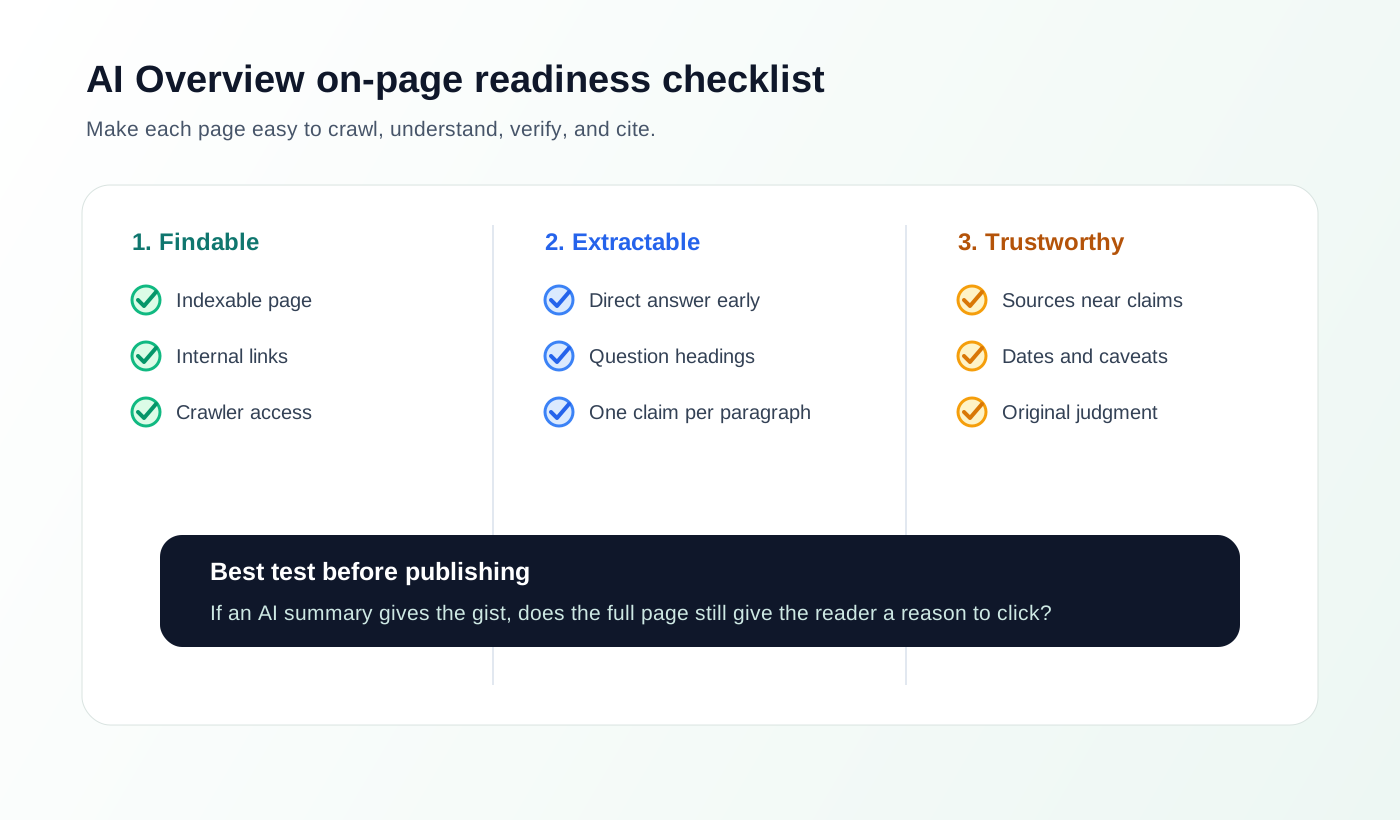
Here is the checklist I would use before publishing a page aimed at AI Overview visibility.
- Is the page indexed and eligible for normal Google snippets?
- Is the main question obvious from the title and introduction?
- Does the page answer that question directly in the first few paragraphs?
- Are the core claims supported by nearby sources, examples, or screenshots?
- Does the article include something original: experience, testing, workflow, or opinion?
- Are important facts dated when freshness matters?
- Are comparison points written in plain language?
- Is the content available as normal text?
- Are internal links pointing to the page from relevant pages?
- Does the page include a clear next step for the reader?
- Would a serious reader still want the full page after reading a summary?
That last question is the most important one.
If a summary removes the need to click, the page probably was not strong enough. If the summary creates a reason to click, the page is doing its job.
11) What I would stop doing
I would stop writing pages that only exist to occupy a keyword.
The weakest format in AI search is the generic overview with no point of view:
- “What is X?”
- “Benefits of X”
- “Top 10 X tools”
- “X vs Y” with no real recommendation
- “Complete guide” that mostly repeats public facts
These can still rank. Some will still get traffic. But they are increasingly easy for AI summaries to absorb.
If you are a small publisher, your edge is not volume. It is specificity.
Write the page that a larger site would avoid because it is too narrow, too opinionated, too practical, or too grounded in messy firsthand experience.
That is where small sites can still win.
12) FAQ
Can you guarantee a page will appear in Google AI Overviews?
No. Google AI Overview inclusion cannot be guaranteed. The realistic goal is to make a page easier to crawl, understand, verify, and cite when it is relevant to the user’s question.
Do AI Overviews only cite pages that rank on page one?
No. Recent research on Google AI Overviews found that nearly 30% of cited domains did not appear in the co-displayed first-page organic results. Classic ranking still matters, but AI Overview citation appears to use a broader source selection process.
What content format is best for AI Overview citations?
The strongest format is usually a focused answer page that combines a direct answer, evidence, examples, caveats, and a practical next step. Generic “complete guides” are weaker when they repeat public information without a clear point of view.
Should small publishers block AI crawlers?
That depends on the publisher’s business model. But if the goal is to appear in AI Overviews, blocking relevant Google crawling paths can reduce retrieval opportunities. A publisher should make this choice deliberately, not by accident through robots.txt, CDN rules, or firewall settings.
Is GEO different from SEO?
GEO, or generative engine optimization, focuses on whether content can be cited inside AI-generated answers. SEO focuses more broadly on crawlability, ranking, snippets, and search traffic. In practice, the best approach is not GEO instead of SEO. It is strong technical SEO plus content that is structured for AI citability.
13) The bottom line
There is no guaranteed way to get cited in Google AI Overviews.
But there is a clear direction.
Google says the basics still matter: crawlability, indexability, helpful content, visible text, internal links, and good page experience. The research adds a more interesting layer: AI Overview sources do not perfectly match traditional rankings, question queries trigger more AI summaries, crawler access affects retrieval, and cited sources often play different roles inside the answer.
So the practical strategy is not “hack AI Overviews.”
It is:
Build pages that are easy to find, easy to understand, easy to verify, and useful enough to support one part of a generated answer.
That is not as simple as classic keyword SEO. But it is also not hopeless.
Small publishers still have a path. They need to write less like content farms and more like people who have actually done the work.
That may be the best news in the whole Google Zero story.
Sources
- Google Search Central: AI features and your website
- Google: AI in Search, going beyond information to intelligence
- Measuring Google AI Overviews: Activation, Source Quality, Claim Fidelity, and Publisher Impact
- How Generative AI Disrupts Search: An Empirical Study of Google Search, Gemini, and AI Overviews
- Pew Research Center: Google users are less likely to click links when an AI summary appears
- GEO: Generative Engine Optimization