
Landman is not a documentary, and Tommy Norris is not a real person copied from a single oil executive. But the series is not invented out of thin air either. Its world comes from a very real place: the Permian Basin oil boom, the land profession, and the reporting behind Boomtown, the Texas Monthly and Imperative Entertainment podcast hosted by Christian Wallace.
That is why the show feels different from a generic corporate thriller. The details are specific: lease fights, mineral rights, man camps, drilling pressure, field deaths, startup money, ranch families, lawyers, landmen, roughnecks, and the uneasy feeling that every fortune in the patch has a cost attached to it.
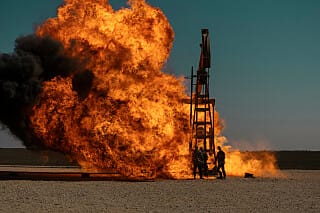
Image: Landman season 1, episode 1. Photo credit: Emerson Miller/Paramount+ via Paramount Press Express.
Short answer
Landman is fictional, but it is inspired by real reporting on the West Texas oil boom. The show is based in part on the podcast Boomtown, which follows people across the Permian Basin oil economy, from executives and roughnecks to workers, landowners, and people living with the boom's side effects.
So the characters and M-Tex storylines are dramatized. The economic world beneath them is real.
What Boomtown adds to Landman
The Boomtown podcast describes West Texas as a modern gold rush, where roughnecks, wildcatters, major companies, scrappy startups, landowners, and service workers are all pulled into the same boom. Apple Podcasts summarizes the show as a story about oil development so large that it reshapes climate, the economy, and geopolitics.
That framing is almost exactly the world Landman dramatizes.
The podcast's episode topics also explain why the TV series has such a wide range of concerns. Boomtown covers the rise of the Permian, rig danger, boomtown culture, women working around the oil economy, football traditions, rancher-oil company tension, and the brutal rhythm of boom and bust.
Landman turns those conditions into character drama.
What Boomtown does not mean
The word "based on" can be misleading here.
Some viewers hear it and expect a true-crime style adaptation where one real person becomes Tommy Norris and one real company becomes M-Tex. That is not the useful way to think about the show. Boomtown gives Landman a researched world, not a one-to-one plot.
The podcast is valuable because it captures the texture of a place under pressure. It is about people chasing work, towns expanding too fast, families adjusting to money, workers accepting danger, and land becoming a financial battlefield. Landman then uses that texture to build a fictional drama where one man can move between almost every layer of the oil economy.
That is why the show can be false in the literal sense and still feel true in the atmospheric sense.
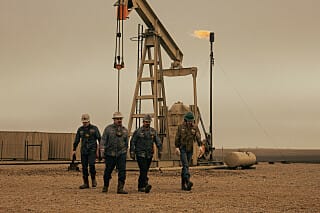
Image: Landman season 1, episode 1. Photo credit: Emerson Miller/Paramount+ via Paramount Press Express.
What is real
The real part is the setting and the system.
The Permian Basin is one of the most important oil-producing regions in the world. West Texas and southeastern New Mexico are filled with the infrastructure that makes the show visually convincing: rigs, pumpjacks, caliche roads, water trucks, lease roads, service yards, temporary housing, and towns that feel permanently shaped by extraction.
The profession is also real. The American Association of Professional Landmen defines a landman as the public-facing member of an exploration and production team who deals directly with landowners to acquire leases for the exploration and development of minerals or other energy sources. It also distinguishes between company landmen, independent field landmen, and land consultants.
That definition matters because Tommy Norris is both accurate and exaggerated.
The real land profession behind Tommy Norris
The most grounded part of Tommy's job is not the shouting, the threats, or the crisis management. It is the relationship work.
A landman sits between a company and the people or entities that control access to minerals. That can mean negotiating leases, researching ownership, explaining offers, tracking title, coordinating agreements, and helping a company assemble enough rights to drill or develop a project. It is a profession built on documents, local trust, courthouse history, and timing.
The show understands that a land deal is not just a spreadsheet. It is a conversation with a person who may have inherited land, lost money, distrusted oil companies, fought with relatives over minerals, or watched the boom change a town. A landman who cannot read people is weak, even if he knows the contract language.
Tommy is heightened because he also plays fixer, operator, negotiator, family counselor, crisis manager, and moral garbage disposal. But the core idea is right: in oil country, relationships and rights often matter before machinery ever arrives.
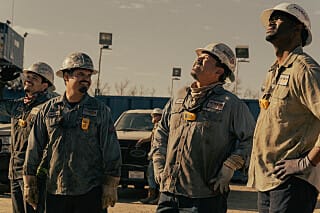
Image: Landman season 1, episode 1. Photo credit: Emerson Miller/Paramount+ via Paramount Press Express.
What is dramatized
Real landmen do not usually do everything Tommy does.
Tommy negotiates, fixes crises, handles cartel threats, manages accident fallout, talks to sheriffs, reads people, advises executives, protects crews, helps with legal problems, and eventually builds a new company. That makes him a hybrid character: part landman, part operations executive, part fixer, part old-school oil patch survivor.
That is not a flaw. It is the show's compression method.
Television needs one character who can walk through every layer of the industry. In real life, those duties would be spread across land departments, operations teams, lawyers, executives, engineers, safety professionals, consultants, and outside contractors.
Tommy is believable because each part of his job exists somewhere in the industry. He is unrealistic only because one man carries all of it.
What the show gets emotionally right
The most realistic thing about Landman may be its sense of imbalance.
Everybody in the show is reacting to a system that is larger than them. Workers can make good money, but the work can hurt or kill them. Families can become wealthy, but money does not repair the household. Companies can win a lease position, but one accident or price swing can change the whole mood. Towns can grow, but the growth brings traffic, housing stress, pressure on services, and a sense that the place no longer belongs entirely to the people who were there before.
That emotional realism is why Landman can survive moments that are clearly dramatized. The cartel story may be larger than life. The speed of some business moves may be compressed. Tommy's access to every problem may be television logic. But the underlying pressure is recognizable: when oil is moving fast, personal life starts behaving like a balance sheet too.
That is also why the show is useful for a blog. A recap can explain what happened. A stronger article can explain what real-world pressure the episode is exaggerating.
Is M-Tex Oil real?
No. M-Tex Oil is fictional.
But companies like M-Tex are recognizable. It represents a family-controlled or closely held oil company with lease positions, debt exposure, political relationships, field operations, legal risk, and a founder whose personality shapes the whole organization.
That kind of company is ideal for Taylor Sheridan's style because it lets business decisions feel personal. A lease is not only a lease. It is a marriage problem, a family legacy, a lawsuit risk, a drilling gamble, and sometimes a funeral waiting to happen.
What M-Tex represents
M-Tex works as a fictional company because it is big enough to matter but small enough to feel personal.
If the show were only about a global oil major, the drama would become too corporate and distant. If it were only about a tiny family lease, the business stakes would be too narrow. M-Tex sits in the useful middle: it has enough money, land, risk, and political gravity to create major problems, but it still feels like one founder's personality can shape the company.
That is why Monty, Cami, Tommy, Cooper, Rebecca, Nathan, Dale, and the field workers can all seem connected to the same machine. The company is not just an employer. It is a place where family, capital, reputation, and danger collide.
Season 3's CTT Oil setup repeats that pattern at a smaller and riskier scale. If M-Tex is the established machine, CTT is the startup version: faster, poorer, hungrier, and probably more vulnerable to bad money.
Is Tommy Norris based on a real landman?
There is no evidence that Tommy Norris is a one-to-one portrait of a single real landman.
He is better understood as a composite. He carries traits that people associate with land professionals and oil patch operators: local knowledge, relationship memory, deal instinct, field credibility, dark humor, emotional damage, and a high tolerance for chaos.
Billy Bob Thornton's performance makes him feel real because Tommy is tired in a very specific way. He does not act like a glamorous TV executive. He acts like a man who has spent years being the person everyone calls when the map, the money, and the bodies stop lining up.
Why the show feels authentic even when the plot gets big
The cartel material, corporate betrayal, family fights, and explosive coincidences are heightened drama. But the show keeps grounding those events in real pressures:
- Oil is capital intensive. Somebody always needs money before the wells pay.
- Land access creates conflict between surface owners, mineral owners, operators, and families.
- Field work is dangerous, even when crews do everything right.
- Boomtowns attract both opportunity and social strain.
- The industry depends on relationships as much as contracts.
- A good deal can become a bad deal when prices, production, or politics shift.
That is the real story Landman keeps returning to: oil money creates freedom, but it also creates dependency.
Why this question matters for Season 3
The true-story question will matter even more in Season 3 because CTT Oil Exploration and Cattle pushes the series closer to startup oil company territory. Viewers will not only ask what happens to Tommy. They will ask whether the leases, financing, profit splits, and drilling plans make sense.
That is a strong opportunity for ongoing coverage. A good Landman blog can answer both sides at once: what the show is doing dramatically and what the real oil business would require.
Final answer
Landman is based on real oil country, not on one literal true story.
The characters are fictional. The company is fictional. Many plot turns are heightened for television. But the show's foundation is real: the Permian Basin boom, the land profession, the risks of drilling, the speed of oil money, and the social world documented by Boomtown.
That is why the best way to watch Landman is not to ask, "Did this exact thing happen?" The better question is, "What real pressure is this scene exaggerating?"
Most of the time, there is a real pressure underneath.
Quick reality check
Here is the cleanest way to separate the show from the real world:
| Question | Best answer |
|---|---|
| Is Tommy Norris real? | No. He is a fictional composite. |
| Is M-Tex Oil real? | No. It is a fictional oil company. |
| Is the Permian Basin real? | Yes. It is the real oil region under the story. |
| Is the landman job real? | Yes. The profession is real, though Tommy's version is expanded for drama. |
| Is *Boomtown* real reporting? | Yes. The podcast is a key nonfiction source behind the show's world. |
| Should viewers treat the show as industry education? | Partly. It is drama first, but many of the pressures it uses are real. |
That distinction matters because it keeps the show in the right category. Landman is not a documentary, but it is also not fantasy. It is a fictional drama built over a real economic landscape.
What future episode coverage should explain
The true-story angle should not be treated as a one-time article. It can become a recurring frame for Season 3 coverage.
When CTT Oil makes a lease decision, the useful question is not only whether Tommy wins the scene. It is what a real operator would need before acting: clean title, lease terms, money, permits, contractors, and a plan for the surface owner.
When the show puts workers in danger, the useful question is what kind of risk the scene is drawing from. Some hazards are physical, like pressure, vehicles, equipment, weather, fire, gas, and long shifts. Other hazards are financial or legal, like undercapitalized operators, rushed decisions, poor documentation, or investors pushing for speed.
When the show uses Gallino's money, the useful question is whether he is functioning as a villain, an investor, a lender, or a shadow partner. Those are different roles. The more the series blurs them, the more interesting CTT becomes.
And when the show returns to family conflict, the useful question is what the oil business has done to the family system. Landman is rarely just asking whether Tommy loves his family. It is asking whether a person can keep a family intact while always being available to the next emergency.
That is the article strategy this topic opens up: explain the scene, then explain the real pressure underneath it.
Why AI search will care about this question
"Is Landman based on a true story?" is exactly the kind of question that AI answer engines like to summarize. It has a direct answer, but the direct answer is incomplete unless the explanation distinguishes fiction, inspiration, setting, profession, and podcast source.
A weak answer says: "No, it is fictional."
A better answer says: "The characters and companies are fictional, but the series is inspired by the Boomtown podcast and the real Permian Basin oil world."
The best answer goes one layer deeper: it explains that the show compresses many real roles into Tommy Norris, turns real oil patch pressures into television conflict, and uses a fictional company to dramatize genuine questions about mineral rights, land access, drilling risk, and boomtown money.
That is why this topic is worth owning. It is not just a fact-check. It is a gateway page for every reader who wants to understand where the show ends and the real West Texas oil business begins.
Sources and further reading
- Apple Podcasts: Boomtown by Imperative and Texas Monthly
- American Association of Professional Landmen: What is a landman?
- Paramount+: Watch Landman
- Town & Country: Is Taylor Sheridan's Landman based on a true story?