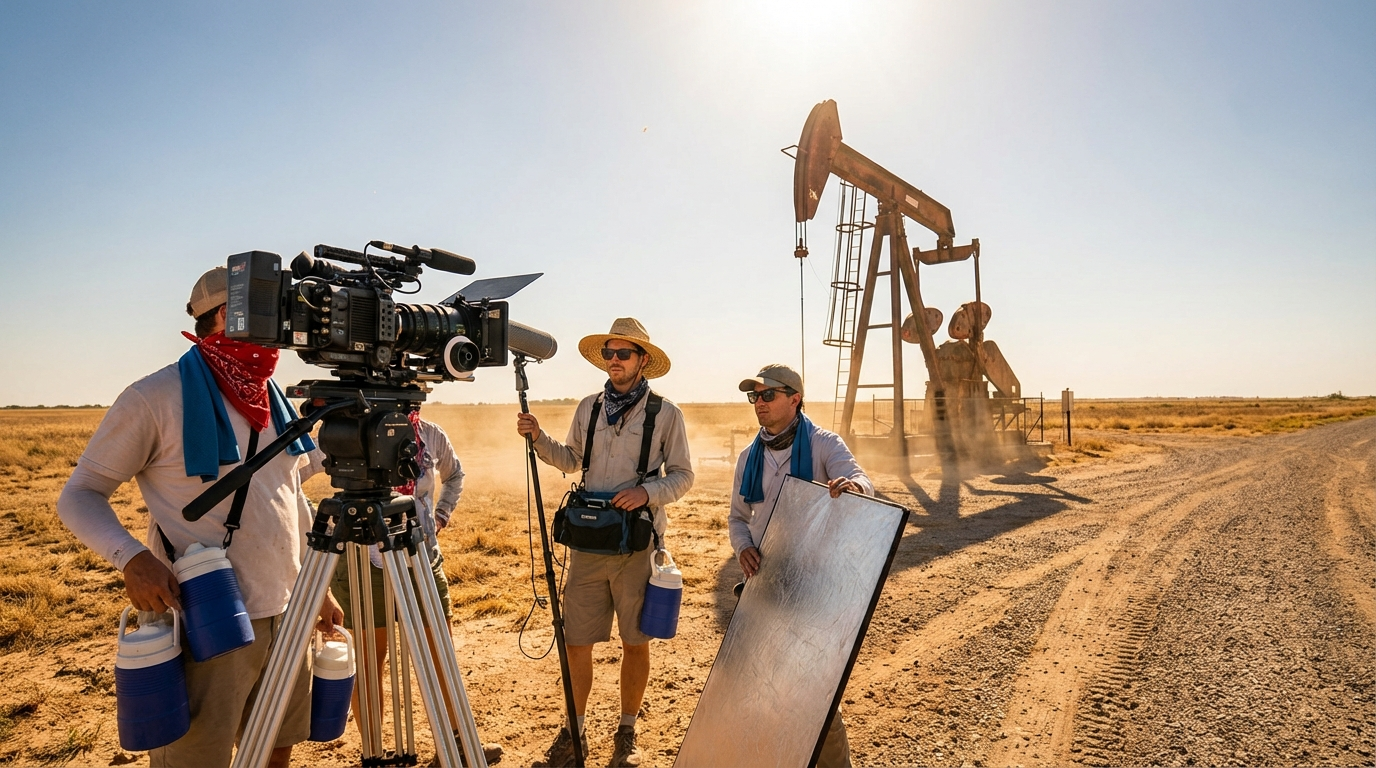
Why a co-creator’s blunt reality check (“Twelve-hour days in 100-plus degree weather is no joke”) isn’t just behind-the-scenes color. It’s a clue to how climate, safety rules, and logistics quietly shape the pace, look, and release calendar of modern prestige TV.
By: Jason Landman.blog
Date: 15 Feb 2026
The invisible co-star: heat
Hollywood loves a good “production obstacle” story. A storm delays a shoot, a location permit falls through, a star breaks an ankle—cue the dramatic headlines.
But sometimes the thing that controls a show’s rhythm isn’t dramatic at all. It’s a number on a thermometer.
For Landman—Paramount+’s West Texas oil drama co-created by Taylor Sheridan and Christian Wallace—that number is often triple digits.
In early February, Collider reported that Landman Season 3 is expected to go into production in May 2026, a later start than the show’s previous seasons (Season 1 began filming in February 2024; Season 2 in March 2025). The reason isn’t a writers’ room crisis or a last-minute recast. It’s simpler—and harsher: Texas heat.
Wallace told The Hollywood Reporter that the later schedule “only matters… because of the heat in Texas,” adding that the show’s many exterior scenes are “a good thing” creatively—because Landman “thrives in the dust and the heat and the reality of that gritty, hot world”—but that it’s also “hard on the crew and cast,” since “Twelve-hour days in 100-plus degree weather is no joke.”
Source: Collider (Feb 4, 2026)
https://collider.com/landman-season-3-filming-start-may-2026-potential-release-delay/
Source: The Hollywood Reporter (Jan 2026)
https://www.hollywoodreporter.com/tv/tv-features/landman-finale-season-3-reset-co-creator-interview-1236477449/
That quote is the kind of line that plays well in a press cycle—rugged, candid, very Texas.
It also raises a bigger question that streaming-era audiences rarely consider:
If climate and heat risk are now serious scheduling factors, how often are our favorite shows being shaped—quietly, materially—by weather?
And in Landman’s case, what does it mean when the environment isn’t a backdrop but a production constraint, a safety problem, and a creative ingredient all at once?
May isn’t “early.” It’s a gamble.
To anyone who has spent time in North Texas, May can feel like the last month before the furnace door swings open.
A May start doesn’t mean the entire shoot happens in May. Modern TV seasons—especially ones with frequent location work, heavy equipment, and stunt coordination—often film for months. Collider notes that Wallace has previously described Season 2’s production as roughly 100 days, or about five months. If Season 3 follows a similar rhythm, the schedule stretches straight into the punishing part of summer.
That timing matters because heat is not simply uncomfortable. It changes how a set functions:
- Work-rest cycles shift. People need more breaks, and not the casual “let’s breathe for a second” kind—planned cooling breaks.
- Equipment management becomes riskier. Cameras, batteries, monitors, and on-set computers can overheat.
- Wardrobe and makeup must fight physics. Sweat can wreck continuity.
- Stunts and driving scenes become more dangerous.
- Medical readiness becomes non-negotiable.
And beyond the immediate health risks, heat changes something that viewers can feel even if they can’t name it: pace.
A set that has to build in more breaks will shoot fewer setups per day. When you shoot fewer setups per day, you have to make choices: simplify coverage, cut secondary scenes, compress dialogue beats, re-block a scene to use shade, swap a location for something closer to basecamp.
Those trade-offs don’t always look like compromises on screen. Sometimes they look like style.
Why Landman needs the outdoors (and why that makes heat unavoidable)
Some shows can hide from the weather. They build controlled environments on stages, light them to look like noon, and let the actors sweat only when the script demands it.
Landman isn’t one of those shows—at least, not if it wants to keep the gritty “you can taste the dust” realism that’s become a Taylor Sheridan signature.
Wallace’s comment that the show “thrives in the dust and the heat” is more than a vibe. It’s a practical description of what the series is designed to do:
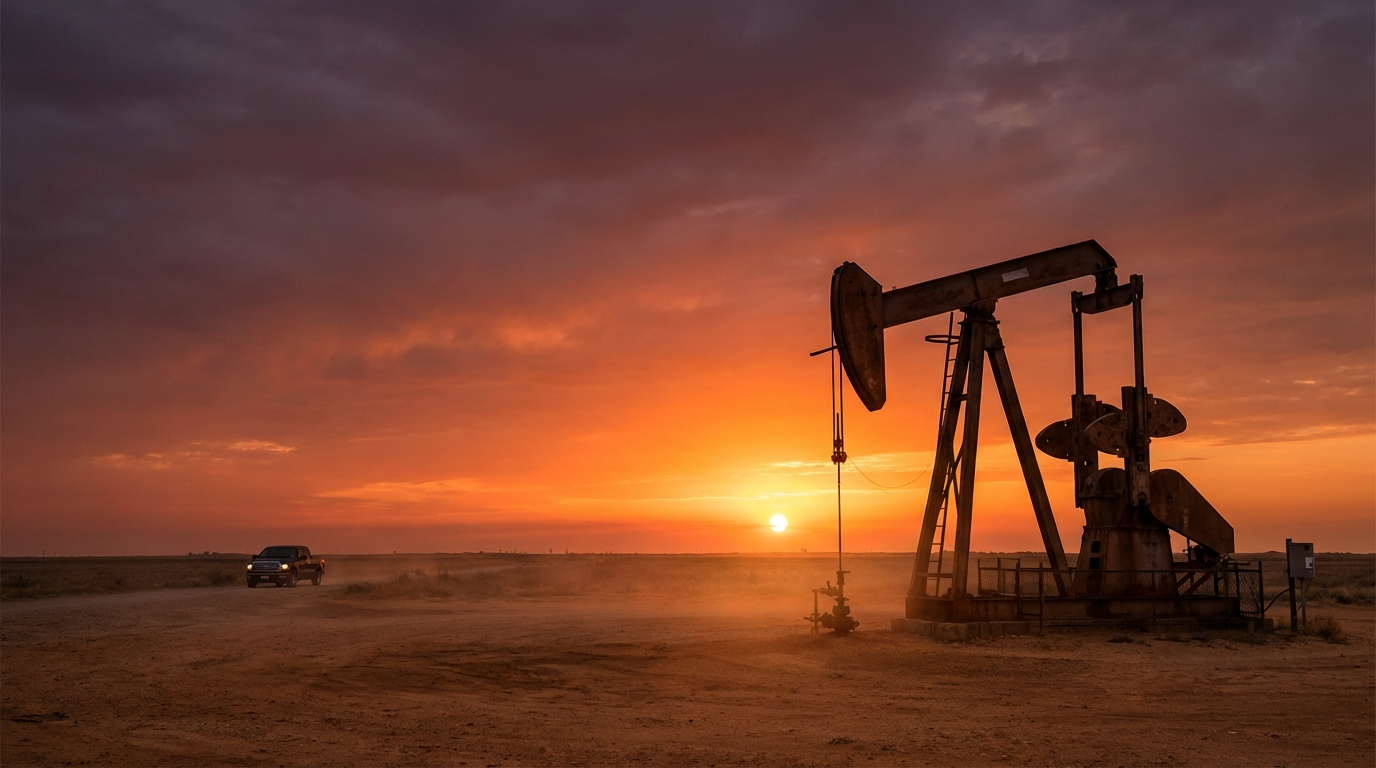
- The Permian Basin and surrounding oil patch are defined by big skies, flat horizons, and brutal sun.
- The story’s stakes depend on a sense of constant exposure—people are always out in it, vulnerable to the elements, running on adrenaline and caffeine.
- The show’s color palette leans into sun-baked yellows and brown industrial textures, which are hard to fake convincingly when you never step outside.
That commitment to exterior shooting becomes part of the show’s identity. It’s why a later start “only matters” because it pushes production deeper into the months where heat is no longer aesthetic—it’s operational.
Heat is a safety issue before it’s a creative one
Let’s be blunt: on a film set, heat is not an inconvenience. It’s an occupational hazard.
Texas’ own insurance and workplace-safety resources explicitly warn productions to plan for it. The Texas Department of Insurance (TDI) includes heat exhaustion monitoring in its film production safety guidance and calls out a common production reality—long days—as a risk factor. Their checklist emphasizes planning, daily safety briefings, and fatigue management, including a recommendation to limit shooting days to no more than 12 hours.
Source: Texas Department of Insurance — “Film production and crew member safety” (Last updated Aug 15, 2025)
https://www.tdi.texas.gov/tips/safety/film-production.html
And it’s not just a Texas thing. Nationally, heat is getting the kind of regulatory attention that used to be reserved for hazards people could see—heavy machinery, fall risk, electrical work.
On its heat standard rulemaking page, OSHA is blunt about the stakes: excessive heat can cause serious health effects, including heat stroke and death, and workers in outdoor settings without adequate controls are at risk.
Source: OSHA — Heat Injury and Illness Prevention in Outdoor and Indoor Work Settings (rulemaking status page)
https://www.osha.gov/heat-exposure/rulemaking
Whether or not a TV production is waiting on a final federal standard before changing how it operates, the message is pretty clear: heat safety is moving from “common sense” to “documented expectation.”
That matters because prestige TV is famously built on speed—tight turnarounds, location-heavy ambition, and delivery dates that marketing teams plan around months (sometimes years) in advance.
What heat does to a set: a practical breakdown
If you’ve never worked on set, it’s easy to picture filming as a glamorous, slightly chaotic version of office work.
In reality, film production is closer to mobile construction—except the “job site” moves constantly, the workday can stretch, and the equipment is a mix of heavy machinery and delicate electronics.
Here’s how heat complicates each layer.
1) Time becomes the most expensive commodity
A 12-hour day in 100-plus degrees isn’t just exhausting. It changes crew performance over time:
- More breaks for hydration and cooling.
- More time setting up shade.
- More time waiting for a safer temperature window.
- More time rotating crew to prevent fatigue.
Every additional minute matters when you’re trying to make your day.
2) Logistics get heavier—literally
Heat forces productions to bring more infrastructure:
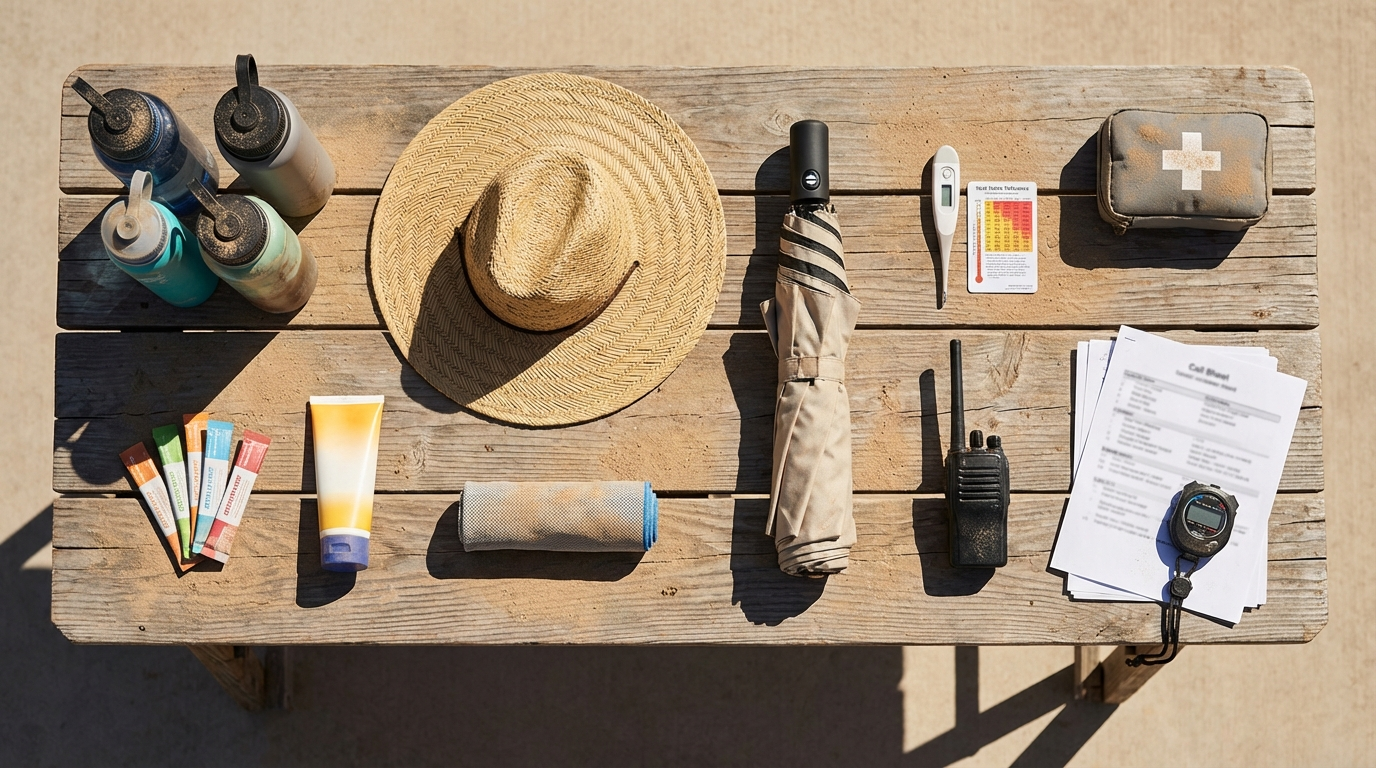
- Portable shade structures (tents, pop-ups, larger overheads).
- Coolers, ice runs, electrolyte supplies.
- Cooling stations and misting fans.
- On-set medical staff and clear emergency plans.
Those aren’t “nice to have.” They’re the difference between a tough shoot and a dangerous one.
3) Continuity becomes a war
In a show like Landman, continuity is a big part of the realism: dust on boots, sweat on collars, a harsh sun angle.
But heat is not consistent. A cloud changes a scene. A sudden wind shifts dust patterns. Sweat appears faster in the afternoon than in the morning.
So the crew ends up fighting two battles at once: maintain the illusion of a single continuous moment, while also keeping everyone safe.
4) Equipment risk rises
Heat stresses:
- Camera sensors and processing units
- Batteries (which can drain faster)
- Wireless systems
- On-set video village monitors
When gear overheats, you don’t just lose time. You risk data loss or equipment failure that can derail an entire day’s schedule.
5) Performance changes
Actors are human. In extreme heat, energy drops, tempers shorten, focus slips.
Sometimes that hurts performance. Sometimes it creates a rawness that fits the story.
Either way, the environment is shaping the result.
When climate starts dictating release windows
Collider framed the May start as a potential cause of release delay. Whether Season 3 hits a similar window as Season 2 depends on how tightly the production and post-production pipeline can run.
This is where streaming-era pressure kicks in.
In the old broadcast model, long seasons and rigid calendars created their own kind of predictability. In prestige streaming, seasons are shorter—but the competition is louder, the churn math is unforgiving, and audiences have been trained to expect a return date that feels “about right.” A platform doesn’t want a flagship show drifting too far from its previous cadence.
So if heat slows production even a little, the ripple effects can get bigger than you’d think:
- A delayed wrap pushes post-production later.
- Post-production delays affect marketing schedules.
- Marketing schedules affect premiere dates.
- Premiere dates affect award eligibility windows and subscriber churn planning.
This is why Wallace’s comment about being “in a groove” matters. It’s not just confidence. It’s a signal that the show has learned how to run its machine under real-world constraints.
And the squeeze is real.
As extreme heat becomes more common—and more dangerous—the old assumption (“we’ll just tough it out”) starts to look less like grit and more like a lawsuit waiting to happen, or worse: a preventable medical emergency.
The irony: the thing that makes Landman look real also makes it harder to make
Wallace’s quote contains a built-in tension:
- The show needs the heat and dust for texture.
- The heat and dust punish the people who create that texture.
That’s a familiar contradiction in physical storytelling.
The most convincing “realism” often comes from real discomfort: cold breath in winter, sweat in summer, mud on boots that isn’t a costume designer’s carefully applied smear.
But the entertainment industry is also facing a labor reality check. Crews are more vocal than ever about working conditions, and safety culture has been reshaped by high-profile tragedies and intense scrutiny.
It’s not hard to imagine a near future where heat-related protocols become as standard as having an intimacy coordinator on set: not a moral signal, but a baseline practice.
What fans can watch for (without being creepy about it)
There’s a thin line between appreciating production realities and treating crew hardship as entertainment.
Still, for viewers who care about how TV is made, heat can become a lens for noticing craft.
Here are a few signs that a show is fighting the environment:
- More scenes in interiors or shaded locations mid-season.
- Tighter coverage (close-ups and mediums) that reduce time moving big rigs.
- A reliance on golden-hour light that compresses the shooting window.
- Dialogue scenes staged under shade structures (not always obvious on screen).
None of this automatically means a show is “cutting corners.” It means it’s making choices.
And the choices can be smart.
A director who understands heat might shoot the most physically demanding sequences early in the day, reserve dialogue-heavy scenes for the hottest hours, and build the schedule around recovery. A cinematographer might embrace the haze and glare rather than fight it.
Heat can be a constraint. It can also be a tool.
A wider trend: production geography is being renegotiated
Landman is not unique in facing climate as a production problem.
Across North America, productions are negotiating wildfire smoke, flooding, hurricane seasons, and extended heat waves. Some shows move locations. Others adjust schedules. Some build more on stages.
Texas, meanwhile, is aggressively positioning itself as a production hub—new studios, growing incentives, and a booming local crew base. The TDI notes that film and television production contributed nearly $2 billion to the state’s economy in 2022 and supported over 54,000 jobs.
Source: Texas Department of Insurance — “Film production and crew member safety”
https://www.tdi.texas.gov/tips/safety/film-production.html
That growth makes the safety conversation even more urgent. When an industry expands quickly, safety culture has to keep up.
And as more productions chase the “authentic” look of real places, more workers will be out in the kind of conditions that climate models say will become more common.
In other words: Landman’s heat problem is also an industry problem.
So… will the heat change the show?
Maybe in ways you can’t plot on a spoiler chart.
Heat won’t rewrite Tommy Norris’ motivations. It won’t decide which character betrays which.
But heat can influence the texture of Season 3 in subtle ways:
- A more compressed timeline on screen (because production days are precious).
- More night scenes (because daytime is punishing).
- A visual harshness that leans even harder into dust, haze, and sun-bleached color.
- A storytelling discipline—fewer “extra” scenes, more scenes that pull double duty.
The fascinating part is that those changes can read as creative intent.
Viewers may call it “tighter pacing.” Critics may praise it as “leaner storytelling.”
Behind the curtain, it may also be the sound of a production learning to survive.
What responsible heat planning looks like (and why audiences should care)
If there’s a takeaway here, it’s not “Texas is hot.” Everyone already knows that.
It’s that the entertainment industry is starting to treat heat like the deadly hazard it is—and that audiences should see that shift as a positive evolution, not a loss of toughness.
Ready.gov, the U.S. government’s public preparedness portal, emphasizes that extreme heat is responsible for the highest number of annual deaths among weather-related hazards, and that high heat and humidity can overwhelm the body’s ability to maintain normal temperature.
Source: Ready.gov — “Extreme Heat” (Last updated Jul 10, 2025)
https://www.ready.gov/heat
When we talk about “what makes a show look real,” we’re also talking about people doing real work in real conditions.
If Landman Season 3 hits screens next year with the same dusty authenticity fans expect, it will be because a lot of professionals—camera crews, grips, electricians, costumers, medics, drivers—did the unglamorous planning that keeps a hot set from becoming a medical headline.
So the next time you watch a sun-baked scene and think, This feels real—you might be right.
And that reality has a cost.
Sources (selected)
- Collider — “'Landman' Season 3 Hit With Unexpected Blow Ahead of Production” (Feb 4, 2026)
https://collider.com/landman-season-3-filming-start-may-2026-potential-release-delay/ - The Hollywood Reporter — “'Landman' Co-Creator Teases Season 3 Reset…” (Jan 2026)
https://www.hollywoodreporter.com/tv/tv-features/landman-finale-season-3-reset-co-creator-interview-1236477449/ - Texas Department of Insurance — “Film production and crew member safety” (Last updated Aug 15, 2025)
https://www.tdi.texas.gov/tips/safety/film-production.html - OSHA — “Heat Injury and Illness Prevention in Outdoor and Indoor Work Settings Rulemaking”
https://www.osha.gov/heat-exposure/rulemaking - Ready.gov — “Extreme Heat” (Last updated Jul 10, 2025)
https://www.ready.gov/heat